


The traditional format and strategy of Test cricket have always involved breaks during the match. The test match lunch break time occurs after two hours of accumulation and is an integral part of the game, and players will use that time to recover, plan tactics, and regain their concentration. Test matches are very much about momentum; as such, the lunch break is very much about the momentum of the match. Instances of weather, delayed over rates, and wickets falling close to the lunch break may slow down the schedule.
What Is Test Match Lunch Break Time?
According to MCC and ICC rules, the test match lunch break is taken after the first day’s play. Typically, the first session lasts 2 hours or 30 overs before the umpires call for the end of the first session, followed by a 40-minute lunch break.
The following is a typical test match timetable:
- First Session – Approximately 2 hours
- Lunch – 40 minutes
- Second Session – Approximately 2 hours
- Tea – 20 minutes
- Third Session – Last session of the day
Under the provisions of MCC Law 12 governing intervals, all lunch intervals must comply with the provisions set out in Law 12.
Read Also: KL Rahul Father Name, Family Details & Personal Life 2026
Test Match Lunch Break Time India
In India, Test matches typically commence at about 09:30-10:00 AM IST. Therefore, most Test matches in India break for lunch around 11:30-12:00 PM IST after the first session of play has concluded. The lunch break lasts for 40 minutes before the second session resumes play.
Test Match Lunch Break Time India:
| Session | Typical Timing |
| Start of Play | 9:30 AM IST |
| Lunch Break | 11:30 AM IST |
| Play Resumes | 12:10 PM IST |
| Tea Break | Around 2:10 PM IST |
| End of Day | Around 4:30 PM IST |
There could be slight variations in the above timings if a game experiences rain delays, poor light or disruption to play.
How Long Is the Lunch Break in Test Cricket?
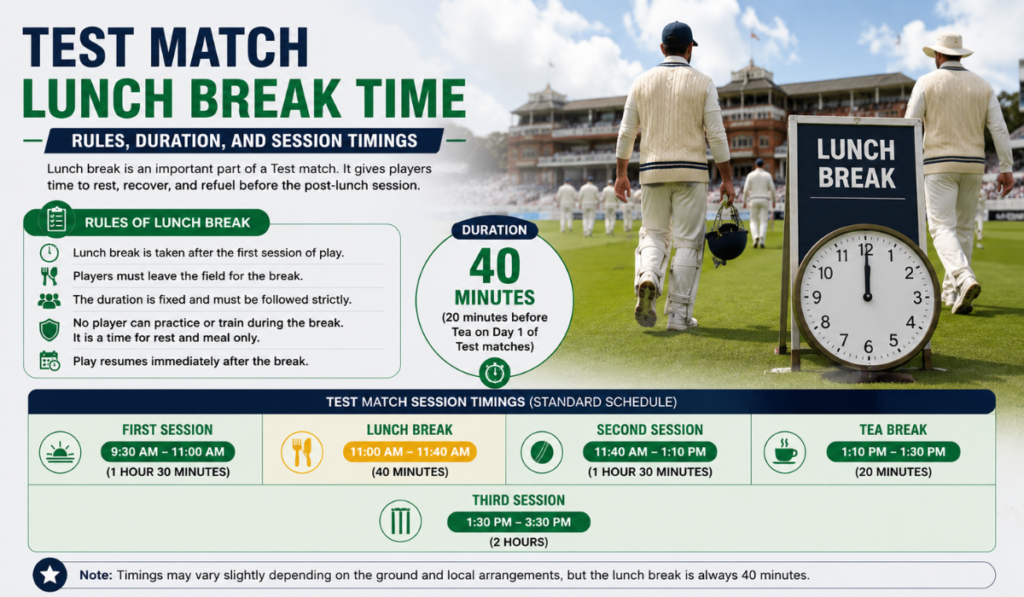
The official lunch interval in Test cricket is 40 minutes long. This duration remains standard across all countries and ICC-sanctioned test matches.
Even if the lunch break starts earlier or later than scheduled, the interval itself generally remains 40 minutes. In rare cases, the match referee may shorten the interval to recover lost playing time after rain interruptions or bad weather.
Rules That Decide Lunch Break Timing
Several factors affect when a lunch break will occur. The umpires will make the decision on when the session ends. Some of these rules include:
- Lunch will typically occur after two hours of play.
- The team bowling must bowl approximately 30 overs before lunch.
- If there are early overs bowled before 30 overs are completed, lunch will begin at that point.
- If the two-hour mark is reached before the 30 overs are completed, the session still ends.
Some unique situations could affect when lunch occurs.
Wickets Falling Close to Lunch
If 8 or 9 wickets are down before lunch, umpires may extend the session up to 30 minutes to complete the innings.
Rain Interruptions
Rain interruptions could cause lunch to be taken earlier or later, due to when the teams will have to continue playing.
Innings Finishing Before Lunch
If a team gets all out or declares close to lunch, it would typically be okay to have lunch soon afterward.
Mid-Over
Lunch is not usually taken in the middle of an over unless there is a wicket that falls directly before or during the time of lunch. Umpires will usually wait until the over is finished unless there is a wicket that is taken immediately before or after lunch.
Read Also: IPL Stump Price 2026: Cost of LED Stumps Used in IPL Matches
Test Match Lunch Break Time in Different Countries
The duration of all test match games is the same throughout the world; however, the local time varies from one country to another because the start time of a test match differs based on location.
| Country | Usual Start Time | Lunch Time |
| India | 9:30 AM | 11:30 AM |
| Australia | 10:30 AM | 12:30 PM |
| England | 11:00 AM | 1:00 PM |
| South Africa | 10:00 AM | 12:00 PM |
| Pakistan | 10:00 AM | 12:00 PM |
| Sri Lanka | 10:00 AM | 12:00 PM |
| Bangladesh | 10:00 AM | 11:30 AM |
| New Zealand | 11:00 AM | 1:00 PM |
Conditions at the venue and weather may also affect the actual start time of the match.
Test Match Sessions Explained
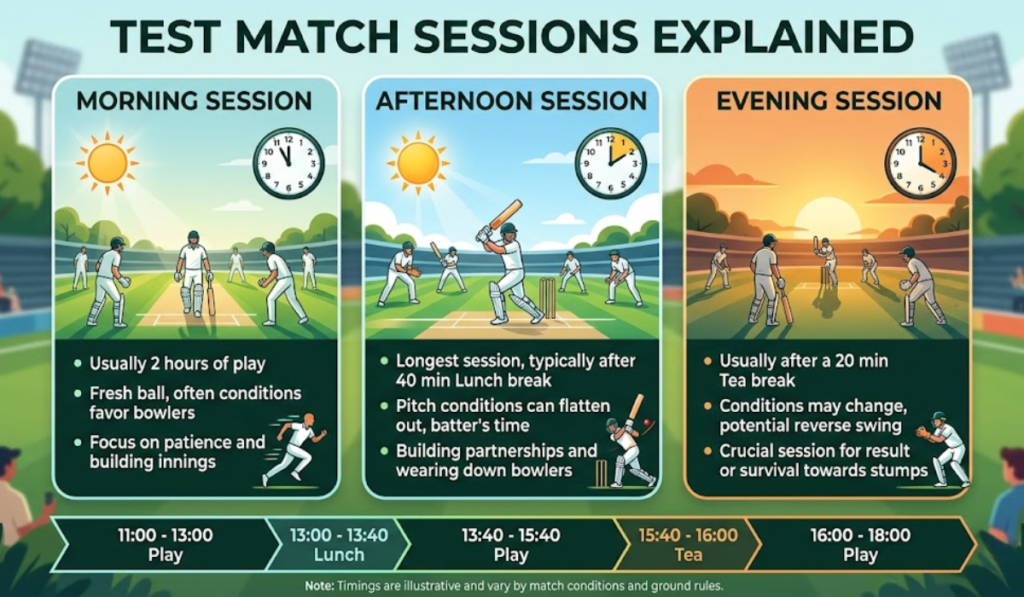
A day of Test cricket is split up into 3 sessions. Each of the sessions has its own relevance in terms of the changing conditions, both on the pitch and in how much energy the players have throughout the course of each day.
Morning Session
The first session is at the start and usually takes place for about two hours. It is the best time for bowlers, as the pitch is still fresh to bowl on with the best chance to get any amount of swing or seam movement.
Afternoon Session
After the lunch break the second session begins. Batting has a much easier time during this session than in the morning, as the pitch has become more settled and the sun has dried up some of the moisture on the surface.
Evening Session
The final session begins after tea. The final session can again benefit bowlers, especially if there is low light towards the end of the day or if there is ball reversing. When the day has ended, the umpire will call it a day.
Other Breaks in Test Cricket
Other than lunch, Test matches have breaks in addition to the lunch break. Day-night tests replace the lunch break with a dinner break, as they begin later in the day.
| Break Type | Duration |
| Lunch Break | 40 minutes |
| Tea Break | 20 minutes |
| Drinks Break | 4–5 minutes |
| Dinner Break (Day-Night Tests) | 40 minutes |
Why the Lunch Break Is Important
Player performance and match tactics rely heavily on the lunch break both as a tool for batters and bowlers to improve their respective skills.
For batters, the lunch break gives an opportunity to:
- Recover after long innings
- Students can ask their coaches about strategies
- Analyze bowlers
- Correct any technical issues
- Regain energy and concentration
For bowlers, the lunch break allows them to:
- Rest from long spells of bowling
- Decrease levels of fatigue
- Plan bowling strategies
- Get the captains to discuss field placement
The psychological aspect of the game is also a big factor in the use of lunch breaks to help shift momentum or adjust the teams’ strategy for the second half of the day.
Read Also: Total International Cricket Stadiums in India
Difference Between Test and Limited-Overs Breaks
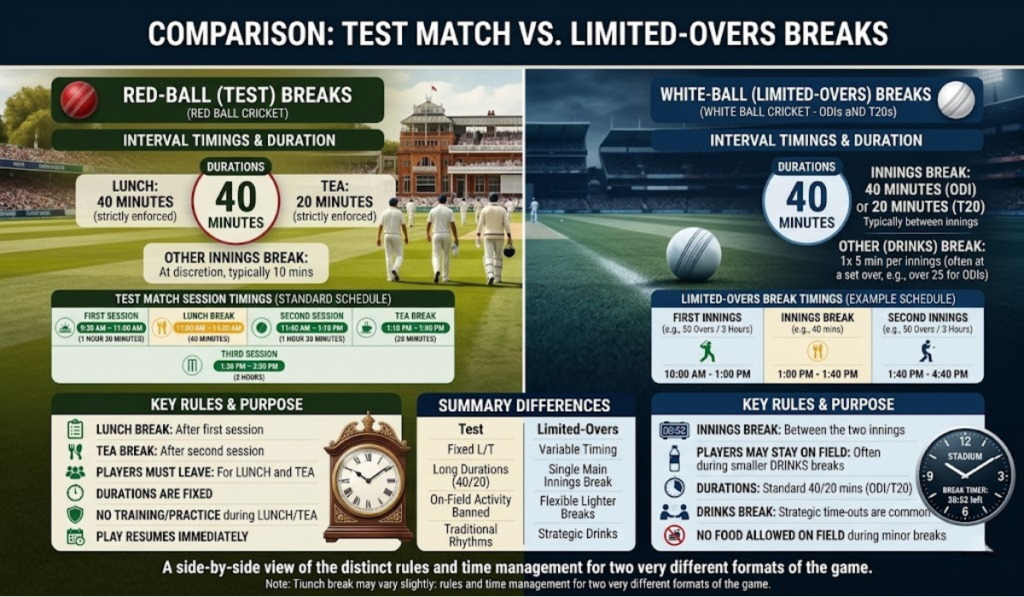
Test cricket’s breaks are longer than for white-ball formats.
In ODI Cricket
Each inning will feature a 40-45 minute break between each inning.
In T20 Cricket
An innings break for T20 matches lasts around 20 minutes. International T20s generally do not have designated drink breaks; however, some leagues (such as the IPL) include a strategic time-out.
The difference in the duration and pace of play in Test cricket compared with ODI & T20 cricket is reflected in the time completely taken for breaks between each inning.
Conclusion About Test Match Lunch Break Time
The test match lunch break time during a match is yet another important component of the traditional format of test cricket and is generally set up an hour after the game starts or after 30 overs have been played. Generally, in India, during most Test matches, lunch occurs at about 11:30 AM IST. While the time frame for this break is well defined, it is possible to modify it slightly based on the weather, wickets, or the situation within the match itself. Understanding the rules regarding these breaks will help the fans better understand the structure of Test cricket and why session management is such an important element of that format.
FAQs on Test Match Lunch Break Time
Q1. What is the lunch break in a Test match?
The lunch interval is generally 40 minutes after the first session in most Test cricket matches.
Q2. What time is lunch in Test cricket?
The lunch break timing varies according to the match schedule, but it usually lasts around 12:00 PM or 1:00 PM local time.
Q3. What is the duration of a lunch break in Test matches?
The standard lunch break period in Test cricket is 40 minutes.
Q4. What is the number of breaks in a Test match?
As per the most basic format of a Test match, there are three sessions a day with two massive breaks: one for lunch and another for tea.
Q5. What exactly goes on during lunch in a Test cricket match?
During lunch break, players will rest, have meals, talk about strategies and prepare for the next session.
Q6. Will lunch break timing change in a Test match?
The lunch break can also be postponed on account of rain interruptions, poor light or obstruction to play.
Q7. The lunch break in Test cricket is decided by whom?
The break is set as per ICC playing conditions, which are followed by both match officials and cricket boards.
Q8. Does the lunch break remain identical across all Test matches?
Types of International Test Matches. While all international test matches are most often played at similar timings, a lot will depend on the country hosting in which season.
Q9. Permission for lunch break and tea break in Test cricket?
Lunch break is late, as well as longer than tea break, which takes place after the first and carries on for a short time, right here, the lunch break.
Q10. Lunch Breaks in Test Cricket: Why are they Important?
A 20-minute interval is treated as a way for players to rest physically and mentally during the exhausting format of the game.














Leave a Reply