

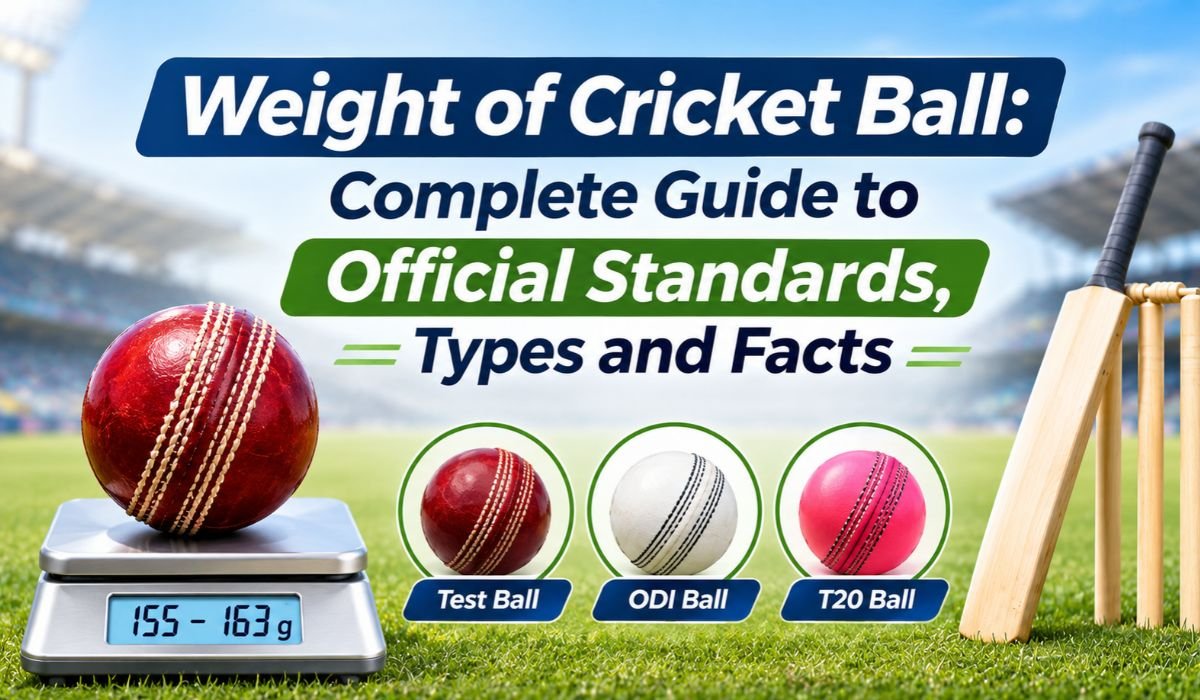
Weight of Cricket Ball: Every cricket fan knows the sound of leather hitting willow. But, few people realize all of the little things that lead up to that instant. A major one is the weight of the cricket ball being thrown during a match. It doesn’t matter if it’s a Test in Melbourne, a T20 in Mumbai, or a “gully” game in Uttar Pradesh, the weight of the ball will affect its ability to swing, bounce and travel away from the bat. This guide explains the official weight of cricket ball according to the Laws of Cricket, how it varies depending on whether it’s for men/women/juniors, how it is determined, and why it is significant to bowlers, batters and fielders.
What Is the Standard Weight of Cricket Ball?
In senior male cricket, the weight of the cricket ball used typically weighs from 155.9g to 163g (approx. 5.5oz – 5.75oz). This range is defined in Law 4 of the Laws of Cricket that are developed and updated by the Marylebone Cricket Club (MCC), and then adopted by the International Cricket Council (ICC) and its constituent board members.
Because the ball is manufactured using raw materials (cork, twine, and leather) and there are variations in the manufacturing process, a range is permitted. Most manufacturers attempt to produce balls weighing approximately 156 to 160 grams, which ensures each ball falls within the legally acceptable weight range.
Official Specifications at a Glance
| Category | Weight (grams) | Weight (ounces) | Circumference |
| Men’s senior ball | 155.9 – 163 g | 5.5 – 5.75 oz | 224 – 229 mm (8.81 – 9.00 in) |
| Women’s ball | 140 – 151 g | 4.94 – 5.31 oz | 210 – 220 mm (8.25 – 8.63 in) |
| Junior ball (about Under-13) | 133 – 144 g | 4.69 – 5.08 oz | 205 – 215 mm (8.06 – 8.50 in) |
Junior numbers may vary based on both the type of board you use and the age group you compete in. Therefore, you should always review the regulations of your local association.
Weight of Cricket Ball in Grams, Ounces and Kilograms
Different countries utilize various units. While India and many other parts of the world employ grams and kilograms to measure items, England and Australia typically utilize ounces. Therefore, when discussing the weight of a cricket ball, there are multiple methods used to quote it; the following table will assist in making those conversions simple.
| Grams | Kilograms | Ounces | Pounds |
| 155.9 g (minimum) | 0.1559 kg | 5.50 oz | 0.344 lb |
| 160 g (typical) | 0.160 kg | 5.64 oz | 0.353 lb |
| 163 g (maximum) | 0.163 kg | 5.75 oz | 0.359 lb |
An easy way to visualize how much weight there is in a standard baseball is that it weighs slightly more than most cell phone batteries, and about the same amount as a big apple.
Weight of Cricket Ball for Women and Juniors
The laws of cricket provide flexibility regarding ball sizes and weights because people of all ages and sizes participate in this game. For example, there are different ball specifications for women’s cricket and junior cricket. Women’s match balls weigh between 140 to 151 grams, whereas junior match balls weigh even less than that. These lighter and smaller balls enable younger players to better grasp, throw, and catch them during play; they also reduce the potential for injuries while the players develop correct playing techniques.
In most cases, young players begin their training with a lighter, softer ball (sometimes as soft as a tennis ball) prior to advancing to a regulation leather ball. It is recommended by many coaches that young players progress only after they are physically capable of holding the ball securely in their hands.
How a Cricket Ball Is Made
Understanding how a hard cricket ball is made explains why its weight remains consistent. There are four main parts to a hard cricket ball:
- The cork core: A small ball made from compressed cork is at the center of the baseball, and it provides the baseball with its ability to bounce.
- A layer of tightly wound twine wraps around the core to increase the diameter of the ball and its firmness.
- Four separate pieces of leather (which have been both tanned and dyed) are formed and sewn together to form a cover for the wound core.
- The seam is a raised line of six rows of stitching that surrounds the center of the ball (equator). This seam provides bowlers with a better grip on the ball and allows them to apply pressure to cause the ball to move in various ways, such as swinging or seaming.
- Every single one of these components adds to the total weight. The weight of a cricket ball is determined by the density of the cork, the tightness with which the string is wrapped around it, and the thickness of the leather. Factory quality control inspections verify that each ball meets the legal weight requirement prior to being sold.
Weight of Cricket Ball in Test, ODI and T20 Cricket
Is the ball heavier in one form of the game than in others? No. There is no difference in the weight of a cricket ball between Test, One Day International (ODI) and Twenty20 (T20) matches. However, the color of the ball does change as does the way it is finished.
| Format | Ball colour | Typical weight | Key notes |
| Test / First-class | Red | 156 – 163 g | Heavier lacquer, seam lasts longer, new ball after 80 overs |
| One Day Internationals | White | 156 – 163 g | Two new balls used from each end in many cases, visible under lights |
| T20 Internationals | White | 156 – 163 g | Harder, brighter finish for big hitting |
| Day-night Tests | Pink | 156 – 163 g | Designed for visibility under floodlights |
The color of the ball will not affect how heavy it is under the rules. Long form cricket uses a red ball, limited overs cricket uses a white ball, and day/night tests use a pink ball.
Weight of Cricket Ball vs Other Balls
The cricket ball is heavier than many other sports’ balls, which helps to put how much it weighs in context.
| Ball | Approximate weight |
| Cricket ball (men’s) | 155.9 – 163 g |
| Field hockey ball | 156 – 163 g |
| Baseball | 142 – 149 g |
| Tennis ball | 56 – 59.4 g |
| Golf ball (maximum) | 45.9 g |
It is interesting that while the weight of a cricket ball is roughly equivalent to that of a field hockey ball, the cricket ball has a significantly greater volume and is thrown at speeds exceeding 140 kilometers per hour by fast bowlers. The combination of mass and speed is what makes safety equipment such as helmets, pads, and gloves necessary for the current version of the game.
Why the Ball’s Weight Matters
The weight of an object may seem like such a trivial detail, but it will have an effect on virtually all aspects of the game.
- As a bowler, a heavier ball will have more momentum. This allows you to bowl faster, with greater force (momentum), and with more potential for the ball to go past the batsman and towards the wicketkeeper. The ability to create movement in the air (swing) and off the pitch (seam) depends heavily on the consistency of the weight of the ball.
- The weight of the ball will determine the amount of power that is transferred from the bat to the ball. When a player drives, pulls, or plays defensively with a baseball that meets the legal limits of size and weight, they will experience a consistent reaction from their bat.
- Fielders must use concentration and strong hand-eye coordination to make catches on balls that have the same weight as the one you are throwing. Fielders will also need to be consistent with each catch to properly determine how far the ball is flying through the air and where it will land.
- To be fair: One side may have an advantage if the ball has a wide range of masses. The laws restrict the weight of the ball to make sure the competition between batter and pitcher remains equal throughout.
Does the Weight Change During a Match?
As a match continues, the cricket ball gets dirty, loses some of its lacquer and begins to wear down on one side because of being hit and polished. Although the weight of a cricket ball does go down slightly during a match, the difference in weight is barely noticeable and does not have an impact on how the game is played.
How much the ball’s surface is affected by its age is what matters most. A fresh ball is firm, bright and moves rapidly from the pitch. An older ball will become soft and coarse on top, aiding reverse swing and spin. Teams playing test matches have the option to use a new ball after 80 overs. Umpires can replace a ball that has been damaged or lost its shape with another ball of equal wear.
Popular Brands and Their Balls
Three brands dominate international and domestic cricket:
- The Kookaburra is used in Australia, New Zealand, South Africa, Pakistan and on white ball international matches. The machine stitched seam will flatten as the ball ages.
- Dukes (England): This type of ball has been used in England and the West Indies. The hand stitching on this ball makes its seam very visible, and it is known for being able to “swing” through the air.
- SG (India): The ball used during test matches in India is manufactured by SG (India), located in Meerut, Uttar Pradesh. It has a high-profile seam that works well with spin bowling and reverse swinging.
The brands are all in the same category of legality, therefore, each brand produces a cricket ball that is within the official weight guidelines; however, the feel and characteristics of each will vary.
How to Check the Weight of a Cricket Ball at Home
You don’t need any specialized equipment to determine how much your cricket ball weighs while you are at home. Just use the following simple steps to find out.
- Take a digital kitchen scale and set it to grams.
- Place the ball gently on the scale and wait for the reading to settle.
- Compare the number to the legal range for your category; i.e., 155.9 to 163g for men’s cricket.
- Repeat once to confirm, since small fluctuations can occur.
If you are purchasing balls for use in a club, it would be wise to weigh some of each group of balls to verify both the consistency and quality.
Conclusion
A cricket ball’s weight may appear to be a minor point; however, the weight is central to the sport. According to the Laws of Cricket, a men’s cricket ball must have a mass of 155.9g-163g. A women’s cricket ball must have a mass of 140g-151g. Junior cricket balls have even less mass and are smaller than senior cricket balls. All forms of international cricket (Tests, ODIs, T20s) use the same mass for each type of ball used (red, white or pink). Knowing this information provides insight into how the game works and why a standard, consistent ball is required for all competitions where bats and balls are used.
FAQs: Weight of Cricket Ball
1. What is the weight of cricket ball in grams?
The mass of a men’s senior cricket ball varies from 155.9g to 163g. Women’s balls range in mass from 140g to 151g, and junior balls are even lighter than both.
2. How heavy is a cricket ball in ounces?
A men’s ball weighs approximately 5.5 – 5.75 oz. and a women’s ball weighs approximately 4.94 – 5.31 oz.
3. Is a red ball heavier than a white ball?
No. Both colors lie within the same weight range of 155.9 – 163 grams. Their differences are in dye, lacquer and visibility, not weight.
4. Who decides the official specifications of a cricket ball?
The MCC creates the laws that govern the game of cricket, such as Law 4 regarding the use of balls. International Cricket Council (ICC) and National Boards adhere to those laws when conducting international and domestic cricket games.
5. Can a cricket ball be lighter or heavier than the legal range?
Senior level matches only. Umpires may disallow a ball that falls out of the prescribed limits. Junior and female categories use different, lighter limits.
6. Does a tennis ball used in street cricket follow the same rules?
No. Tennis balls have a mass of approximately 56 to 59 grams, so they do not fall under the purview of the official laws governing baseballs. Due to being lighter and therefore safer, tennis balls are often used during informal games.










Leave a Reply