

World Fastest Ball in Cricket: The sight of a fast bowler running toward you and then throwing the ball so fast you hardly know what hit you, has to be one of the best moments in sports. But a “world’s fastest” in cricket isn’t just a number on a display screen. It represents the maximum amount of force, skill, and nerve a person can generate. In this article, I will discuss the record; the bowlers who were close to breaking it; how they measure speed; and whether or not it may someday be broken.
What Is the World Fastest Ball in Cricket?
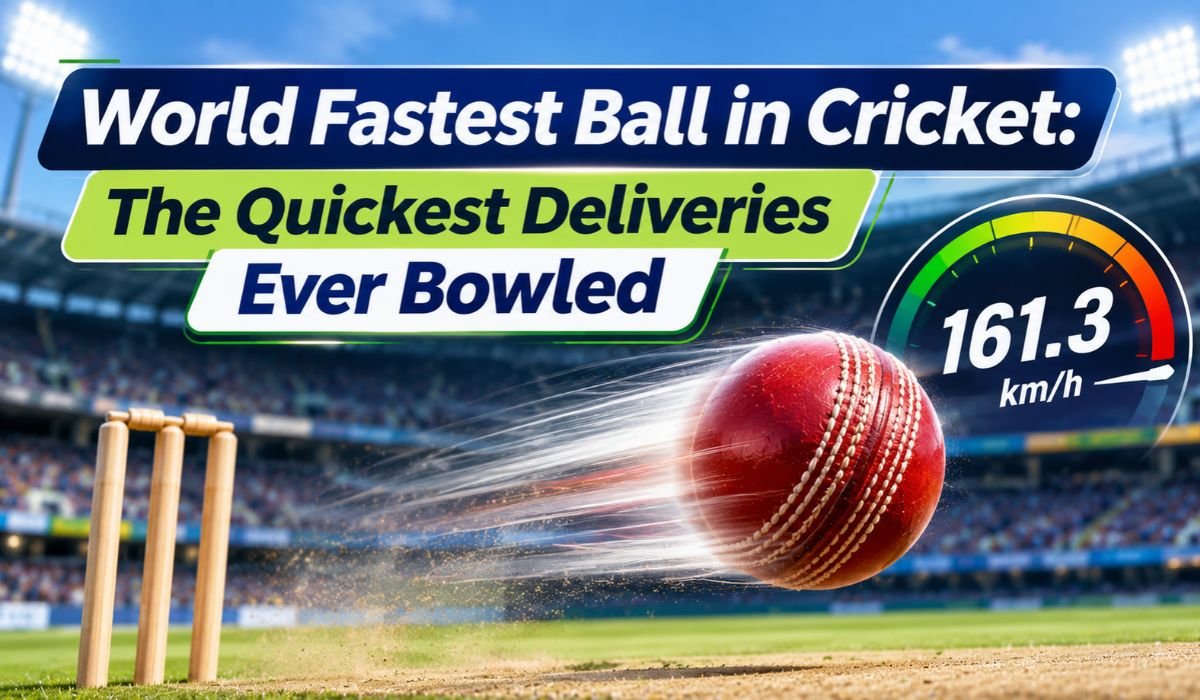
The world fastest ball in cricket, according to official records, was bowled by Pakistan’s Shoaib Akhtar, also known as the “Rawalpindi Express.” Shoaib recorded 161.3 km/h (100.2 mph) during a 2003 World Cup match against England in Cape Town, South Africa. This was the first time that a bowler had recorded a speed of 100 mph, and the record remains intact after more than 20 years.
Akhtar’s delivery was recorded on radar and broadcast live on TV. He used a long, smooth run-up and a slingy, high-arm delivery to bowl to Nick Knight, the batsman from England. Fast bowlers have been trying to reach the 100 mph barrier for years, but Akhtar did so with this delivery.
Shoaib Akhtar’s Record-Breaking Spell
Akhtar established himself in the world of cricket based on sheer speed. He appeared in 46 Test matches, 163 One Day Internationals (ODIs) and 15 Twenty20 International (T20I) matches for Pakistan. Throughout his career, Akhtar would consistently bowl at speeds in excess of 150 km/h. His quickest delivery continues to be used as a standard to evaluate all fast bowlers.
The career of this fast bowler may have had some controversy and injury along the way, however, he always had the ability to go fast. He tormented some of the top batsmen in the world such as Sachin Tendulkar, Ricky Ponting and Brian Lara. The two dismissals of Tendulkar and Rahul Dravid with back-to-back deliveries during the match played in Eden Gardens in 1999 are still considered to be one of the greatest fast bowling spells ever.
Top Fastest Deliveries in Cricket History
Several other bowlers have come within touching distance of the record. The table below lists the quickest officially reported deliveries. Figures can differ slightly between sources because of the equipment used, so treat them as approximate.
| Rank | Bowler | Country | Speed (km/h) | Speed (mph) | Year |
| 1 | Shoaib Akhtar | Pakistan | 161.3 | 100.2 | 2003 |
| 2 | Shaun Tait | Australia | 161.1 | 100.1 | 2010 |
| 3 | Brett Lee | Australia | 161.1 | 100.1 | 2005 |
| 4 | Jeff Thomson | Australia | 160.6 | 99.8 | 1975 |
| 5 | Mitchell Starc | Australia | 160.4 | 99.7 | 2015 |
| 6 | Andy Roberts | West Indies | 159.5 | 99.1 | 1975 |
| 7 | Fidel Edwards | West Indies | 157.7 | 98.0 | 2003 |
| 8 | Mitchell Johnson | Australia | 156.8 | 97.4 | 2013 |
| 9 | Lockie Ferguson | New Zealand | 157.3 | 97.7 | 2022 |
| 10 | Mayank Yadav | India | 156.7 | 97.3 | 2024 |
There are many other bowlers that were very close to breaking the record. This table displays the fastest officially recorded delivery times. Because different equipment is used, the times may vary from one source to another, so you should use these times as approximations.
The top five entries in this list, which reflect Australia’s history of fast pace bowlers, are all within one kilometer per hour. If you want to know who has World Fastest Ball in Cricket, you will find it here.
Jeff Thomson and the Pre-Radar Era
Many fans have stated that the speed of bowlers from previous generations was equal to the current generation, however, they were not measured accurately. The most notable example of this is Jeff Thomson of Australia. During 1975, Thomson was clocked at approximately 160.6 km/h (99.8 mph) with the help of a laboratory-based measurement system. This system measured the velocity of the ball a few meters after it had been released.
Thomson’s unusual sling-type motion was similar to that of a javelin thrower, allowing him to generate tremendous velocity through his shoulders and back. Many legendary players such as Frank Tyson, Harold Larwood, Michael Holding and Wes Hall have been described as being incredibly fast. However, because there was no standardized means of measuring during that time, it would be unfair to compare their statistics with those of today’s players. Therefore, World Fastest Ball in Cricket is generally attributed to a bowler from the “television” generation, where measurements could be consistently taken.
How Is Ball Speed Measured in Cricket?
The most common type of speed gun used today is based upon Doppler Radar. This technology measures the velocity of the cricket ball from the moment it leaves the bowlers hand. Some other technologies that have been developed for measuring the speed of a cricket ball include High-Speed Cameras and Ball Tracking Technologies (such as Hawk-Eye). Each of these technologies can determine the speed of the cricket ball at different stages of the bowling action, so there may be variations in the measurements obtained.
Key points about measurement:
- The rate at which you throw a baseball is measured from the time the ball leaves your hand to when it hits the glove, providing the maximum rate.
- The speed of the ball is reduced after it has bounced off the ground, therefore the measurements taken will be lower.
- Calibration: Equipment must be calibrated for each ground, and errors do occur.
- The International Cricket Council (ICC) doesn’t have an official list of records; therefore, the term “official” typically means the widely accepted broadcast records.
Because there are many differing viewpoints about who has thrown the World Fastest Ball in Cricket, some people believe that no one can say for sure which person holds that record. However, Shoaib Akhtar’s 161.3 km/h is generally agreed upon as the top speed.
The Science Behind Extreme Pace
At 160 kilometers per hour, bowling is a total body activity. The fast bowler runs toward the pitch, sets his front foot, turns his hips and upper body, then brings his arm around. Power is transferred from the surface up through the bowler’s legs, trunk, shoulders, and lastly his hands.
Several factors influence speed:
- Run-up momentum: A smooth, powerful approach builds speed before delivery.
- A solid front foot provides a strong base for an athlete’s front leg to act as a pole vault, which allows for energy to be transferred from the lower body to the upper body.
- The greater the distance between the hips and the shoulders (hip-shoulder separation), the more potential energy can be stored.
- Arm Speed & Wrist Snap: The last part of the motion (the fastest part) is when you pull your arm and wrist forward as fast as possible.
- The bowler’s height and body type will determine how far down the pitch he releases the ball and also how much of his arm he can use as a lever.
In terms of time, at 160 km/h, the cricket ball will cover the 20.12 meters of the pitch in approximately 0.45 seconds. This means that a batsman has less than 0.50 seconds to determine where the ball is going to hit the pitch, how long it will be on the pitch, and what kind of movement it will have after hitting the pitch. Because of this, the fastest delivery in cricket is both a test of reflexes and of skill.
Fastest Balls in T20 and the IPL
In T20 leagues such as the Indian Premier League (IPL), fast bowlers have continually broken speed barriers. Lockie Ferguson, Anrich Nortje, Umran Malik, and Mayank Yadav have each delivered at least one ball that was clocked at 155 km/h or faster. In addition, Umran Malik and Mayank Yadav have caught the attention of many people in India because they demonstrated that Indian bowlers can achieve extremely high speeds as well.
In shorter forms of the game, pace is rewarded because batsmen do not have much time to react, and a yorker at 150 km/h is almost impossible to play. Nevertheless, the fastest delivery ever bowled in cricket remains that from 2003, with none of today’s T20 bowlers having broken that record.
Fastest Ball in Women’s Cricket
Women’s cricket also has its own speed marks. In 2016, South Africa’s Shabnim Ismail was the first to be credited with the fastest delivery ever recorded in women’s cricket at approximately 128 km/h. Other fast bowlers include Australia’s Lea Tahuhu and England’s Katherine Brunt. Although women’s cricket does not reach the same speeds as men’s cricket due to physical limitations, the overall pace of women’s cricket continues to grow as training methods improve and professional systems develop.
Can the Record Ever Be Broken?
Many sports science professionals state that the 100 mph barrier may be the absolute upper limit of human performance. However, bowlers continue to approach this speed. As sports science, biomechanics, strength training, and nutrition continue to advance, the record could potentially fall in the future.
Obstacles include:
- Injury risk: Extreme speed puts huge stress on the back, shoulder, and knees.
- Team workload management: modern-day teams restrict their players’ amount of overs played, therefore bowlers seldom have to provide maximum effort over an extended period.
- Accuracy trade-off: Pace without control is rarely rewarded in modern cricket.
And yet, every year, young talented players continue to emerge from all over the world. To be able to break the current record of being the fastest bowler ever in the history of cricket, you would have to possess both incredible physical abilities, as well as excellent technique, and most importantly, be completely healthy at the time of your attempt to set the record.
Why Fast Bowling Still Thrills Fans
In addition to changing the way we view the game, the presence of a fast bowler on the field changes the whole environment. The fans get into the game, the batsmen tighten up, and the wicket-keeper stands way back. Speed can be scary, and fear can lead to mistakes. Many of the greatest bowlers in history (Dennis Lillee, Malcolm Marshall, Wasim Akram, Waqar Younis, Dale Steyn, and Glenn McGrath) have demonstrated that when you combine speed with skill, it is an extremely effective combination.
The search for the World Fastest Ball in Cricket has inspired young bowlers to pursue cricket. Many of these players start playing the game with the hope of being included in the list of fastest bowlers, and each year there is at least one new prospect for “fastest” who emerges from either domestic or franchise cricket.
Conclusion about World Fastest Ball in Cricket
In terms of being the fastest delivery in cricket history, Shoaib Akhtar’s 161.3 km/h (100.2 mph) delivery in 2003 is still regarded as the correct answer. Brett Lee, Shaun Tait, Jeff Thomson, and Mitchell Starc all came very close to Akhtar’s mark, and there are other young bowlers coming up like Mayank Yadav and Umran Malik that will continue to challenge for the title. As long as no one officially passes Akhtar’s mark of 161.3 km/h, his name will remain at the top of the record books.
FAQs: World Fastest Ball in Cricket
1. Who bowled the world fastest ball in cricket?
Shoaib Akhtar from Pakistan bowled it. He hit 161.3 km/h (100.2 mph) during his bowling spell against England in the 2003 World Cup. This is currently regarded as the most generally accepted world fastest ball record in cricket.
2. Has anyone bowled 100 mph in cricket?
Yes, there are three players who have achieved speeds of approximately 100 mph (around 160.9 kilometers per hour) during international cricket matches. These players are Shoaib Akhtar, Brett Lee, and Shaun Tait.
3. Who is the fastest Indian bowler?
The fastest recorded delivery from an Indian bowler in the Indian Premier League (IPL) was made by Umran Malik and Mayank Yadav, with speeds of approximately 156-157 km/h. To date, no Indian bowler has matched or exceeded the top speed of a cricket delivery anywhere in the world.
4. Is Jeff Thomson’s delivery considered a record?
The speed of Thompson’s pitch in 1975 was approximately 160.6 km/h; however, the method used to measure it is significantly different from what we use today. Therefore, although it is considered a significant historical reference point for fast pitching in cricket, it is not officially recognized as the World Fastest Ball in Cricket.
5. How is the speed of a cricket ball measured?
Radar guns and Hawk-Eye tracking devices measure speed. Speed measurements are taken at, or near, the time of release; however, there may be some differences in the speed measurement taken by each device.
6. Who bowled World Fastest Ball in Cricket?
The female fast bowler with the most recognized fast ball is South Africa’s Shabnim Ismail, who recorded a speed of approximately 128 km/h (80 mph) in 2016.





Leave a Reply